Quick snapshot (what this product promises)
-
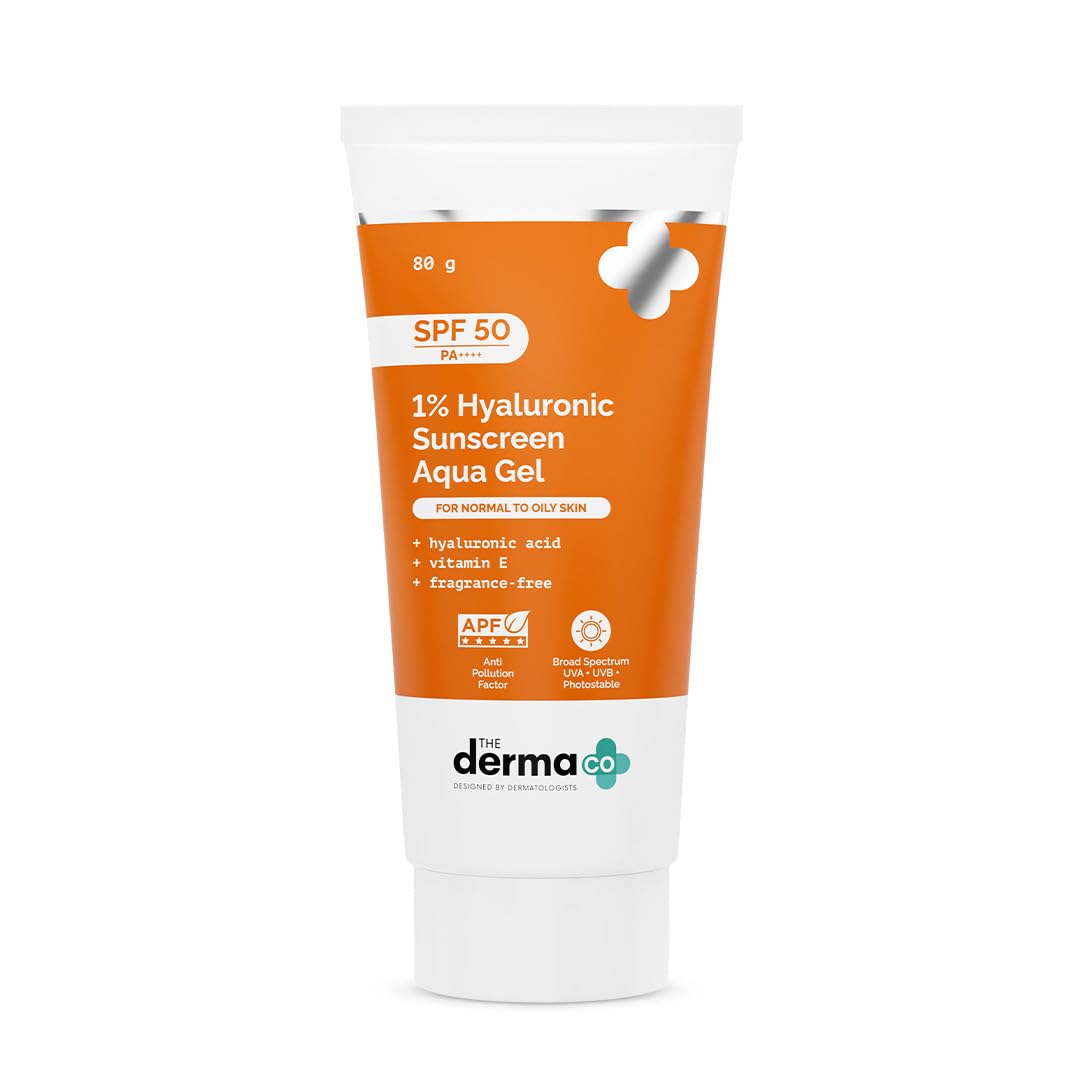
Format: lightweight aqua gel (water-based feel).
-
Active protection: SPF 50 / PA++++ (broad-spectrum claim).
-
Skin benefit claimed: 1% Hyaluronic Acid for hydration without greasiness; marketed for oily, acne-prone and combination skin.
-
Texture/finish: marketed as non-greasy, no white cast, fast absorption.
In-depth, evidence-based review
1) Formula and ingredients — what matters for oily skin
The Derma Co’s headline ingredient is 1% hyaluronic acid — a humectant that attracts and holds water in the skin. Hyaluronic acid itself doesn’t make skin oily; in fact, in low concentrations and watery vehicles it helps hydration without adding oils. But hyaluronic acid is not a mattifying or oil-control active — it hydrates. What actually determines whether a sunscreen suits oily skin is the overall vehicle (water/gel vs cream/oil), presence of oil-forming emollients, comedogenic ingredients, and lightness of finish. The Derma Co uses an aqua-gel (water-based) vehicle which, by formulation logic, tends to perform well on oily skin since it’s lighter and absorbs quickly.
Practical takeaway: Hyaluronic acid is a hydration plus — but the aqua-gel base is the real reason oily skin users find this comfortable.
2) UV protection claims & stability
SPF 50 and PA++++ are strong protection claims appropriate for daily and outdoor use in India. There’s no public, independent lab data attached to the Amazon listing; so we accept the manufacturer’s photostability claim but must note real-world protection depends on application amount and reapplication frequency (most people apply much less than the tested 2 mg/cm²). Always reapply every 2–3 hours in sun exposure.
3) Texture, finish & wearability (real user signals)
With 34k+ reviews and a 4.2★ average on Amazon India, the product clearly resonates with many users. Common practical reports (from reviews and product description excerpts) describe it as lightweight, non-greasy, and with minimal white cast — which aligns with what an aqua-gel should feel like on oily skin. That said, Amazon review pools include a range of experiences: some users still report mild tackiness or pilling with layering (when used with heavy serums/moisturizers).
4) Safety & suitability for acne-prone/oily skin
Key points for oily/acne-prone skin:
-
Non-comedogenic labelling helps but is less regulated—look at personal reaction.
-
The watery gel format plus absence of heavy occlusive oils make this a reasonable choice for oily skin.
-
If you have active acne, patch test first (every skin reacts differently), and avoid layering heavy emollients under it.
Overall: good suitability for oily/combination skin when used correctly. Expert commentary on oily-skin sunscreen picks also emphasizes gel/fluids and oil-control formats — a category the Derma Co fits into.
5) Value & packaging
At ~₹552 (often sold in multiple sizes/packs), the Derma Co sits in the budget-to-affordable bracket. For daily use, cost per ml is competitive versus premium brands (La Roche-Posay, Isdin, etc.). Many users repurchase, which is reflected in the high review count.
How it compares to major, well-known competitors (India)
I compared it against widely used alternatives that Indian buyers commonly consider:
A — Neutrogena Ultra Sheer Dry-Touch SPF50+ (chemical, dry-touch)
-
Strengths: long-standing market reputation, lightweight, often gives a matte finish, widely available and affordable.
-
Consider vs Derma Co: Neutrogena is proven to many users for matte finish and primer-like feel; Derma Co’s aqua gel is similarly light but may feel more hydrating (thanks to HA). If you’re specifically after the driest/matte finish, Neutrogena often edges out.
B — La Roche-Posay Anthelios / Anthelios UVMune (premium)
-
Strengths: excellent filter systems, very reliable UV protection, dermatologist-approved reputation, superb for sensitive skin variants.
-
Consider vs Derma Co: La Roche-Posay is a premium choice with proven clinical backing; texture options include fluid/dry touch variants good for oily skin, but price is much higher. If budget isn’t a constraint and you want a tried-and-tested lab-backed product, La Roche-Posay may be preferable.
C — Cetaphil / Mineral options (mineral sunscreens)
-
Strengths: mineral sunblocks (zinc/titanium) are gentle and often better for sensitive/acne-prone skin; newer formulations reduce white cast.
-
Consider vs Derma Co: Mineral formulas can be better at oil control for some people, but many mineral sunscreens leave a visible cast on deeper skin tones unless they are tinted. Cetaphil’s sheer mineral offerings are good, but more expensive.
D — Mamaearth / Minimalist (Indian, budget to mid)
-
Strengths: local pricing, formulations targeted to Indian weather (some lightweight gels), often marketed for no white cast.
-
Consider vs Derma Co: Mamaearth and Minimalist have variants that compete closely on texture and price. If you prefer a brand with a longer domestic marketing track record or specific ingredients (turmeric, carrot seed, niacinamide blends), compare ingredient lists. Mamaearth’s ultra light sunscreens are frequently recommended for oily skin too.
Comparison summary:
-
Best matte / oil-control finish: Neutrogena UltraSheer (dry-touch) often leads.
-
Best clinical/dermatologist-backed option: La Roche-Posay (but at a higher price).
-
Best budget gel for oily skin (value): The Derma Co Aqua Gel competes strongly due to gel texture + lower price and large user base.
Is this the best sunscreen for oily skin in India?
Short answer: Not universally — but it’s one of the best value gel options.
Why not “the best” for everyone?
-
“Best” depends on personal priorities: absolute mattifying finish, clinical backing, mineral vs chemical filters, skin sensitivity, skin tone (white cast concerns), and budget.
-
Dermatologists and experts (e.g., popular editorial roundups) often recommend a shortlist—some include La Roche-Posay, EltaMD (not widely available in India), Neutrogena, or specialized mattifying mineral sunscreens for oily skin. Gel/aqueous formats like The Derma Co are recommended for oily skin types, so it’s definitely a strong contender—especially for budget-minded buyers.
Practical tips for oily skin users who choose this product
-
Apply the correct amount (pea-to-nickel size for face is usually short of lab amounts)—apply liberally for reliable SPF.
-
Layering: use a light water-based serum or gel moisturizer underneath; avoid heavy oils that will reduce the matte feel.
-
Reapplication: every 2–3 hours if outdoors, after sweating or towel-drying.
-
Patch test first if you’re acne-prone; large review volumes show many do well, but everyone’s skin differs.
Final unbiased verdict (for Indian buyers)
Pros
-
Lightweight, non-greasy aqua-gel format that suits oily and combination skin.
-
Strong protection claim (SPF50 / PA++++).
-
Extremely popular on Amazon (34k+ reviews, ~4.2★) which indicates repeat purchases and broad acceptance.
-
Very good value at ~₹552 — affordable daily-use option.
Cons / caveats
-
Hyaluronic acid helps hydrate but won’t control oil — you still need a mattifying routine if shine is your main concern.
-
Not a premium, lab-published sunscreen like some La Roche-Posay or selective medical brands (which have more clinical data/publications).
-
Some users report mild tackiness/pilling if layered with heavy products.
Bottom line:
If you want a budget-friendly, lightweight gel sunscreen that performs well for daily use and is widely loved by users in India, The Derma Co 1% Hyaluronic Sunscreen Aqua Gel SPF50 PA++++ is worth buying — especially for oily/combination skin users who prefer a non-greasy texture.
If your priorities are clinically proven photostability, the driest matte finish, or premium dermatologist-grade assurance, consider La Roche-Posay or Neutrogena UltraSheer as alternatives (at higher price points).
Buy it here: https://amzn.to/3Nzu7jd